
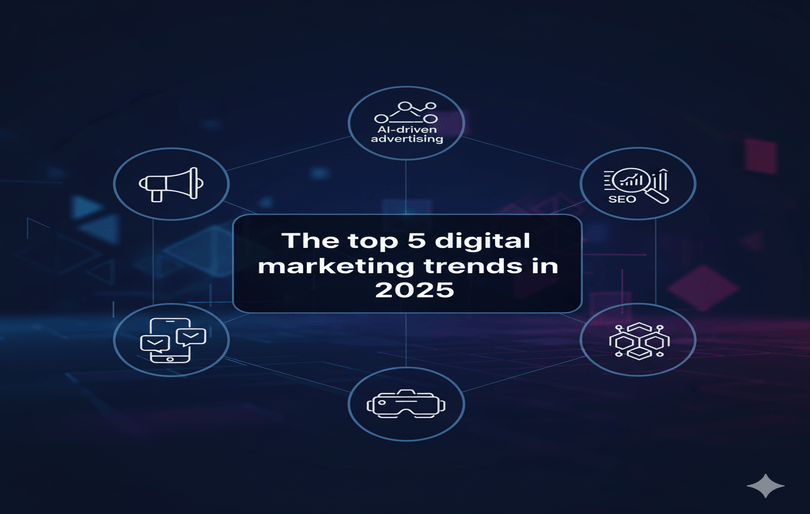
In this article, we discuss the top 5 digital marketing trends in 2025. The world of digital marketing moves fast. What worked last year might not work today. Staying on top of the latest digital marketing trends is not just a good idea; it’s essential. It is essential for the growth of your business.
In 2025, the most significant shifts are underway. They are driven by artificial intelligence and a demand for more genuine, helpful customer experiences. People are tired of generic ads. They want conversations. They want help. They want brands to understand them.
Choosing the right tools is the first step; implementing them effectively is what truly drives growth. For marketers and business owners looking to seamlessly integrate these power-ups into a winning strategy, partnering with me can accelerate your results. Hi, I’m Muhammed Kareem, the best digital marketing freelancer in Kochi, specializing in building efficient systems that leverage these technologies to their full potential. You can see my hands-on approach on my website or start a conversation at scalewithmuhammed@gmail.com.
This article will walk you through the five most important digital marketing trends for 2025. We will explain what each trend is in simple terms. We will show you why it matters. And we will give you practical steps you can take to use it for your own business. Let’s dive in.
Contents
- 0.1 Trend #1: AI-Powered Personalization at Scale
- 0.2 Trend #2: Search Gets Smarter with Google’s SGE (Search Generative Experience)
- 0.3 Trend #3: The Voice Search Revolution is Here
- 0.4 Trend #4: Interactive Content: Engage, Don’t Just Tell
- 0.5 Trend #5: Social Commerce Matures: Shopping in the App
- 1 Your Action Plan for 2025
- 2 Frequently Asked Questions (FAQs)
Trend #1: AI-Powered Personalization at Scale
Imagine walking into a store where the salesperson knows your name, your favorite colors, and what you bought last time. They show you exactly what you’re looking for. That is the power of personalization. For a long time, doing this online for thousands of customers was impossible. Now, it is not only possible—it’s expected.
This is one of the most impactful digital marketing trends. AI helps us move beyond just using a customer’s first name in an email. It allows for deep, real-time personalization across every touchpoint.
What This Trend Is All About
AI-powered personalization means using artificial intelligence to collect and analyze customer data. Then, it uses that analysis to deliver a unique experience to each person. This could be a custom website landing page, a product recommendation, or a special offer sent at the perfect time.
For example, Netflix uses AI to recommend shows you might like. Amazon uses it to show you products based on your past purchases. Now, this technology is available to businesses of all sizes.
Why It’s a Game-Changer in 2025
Customers have come to expect this. A generic marketing message is easy to ignore. A personalized message feels helpful and relevant. This leads to:
- Higher Conversion Rates: People are more likely to buy when you show them what they want.
- Increased Customer Loyalty: When a brand makes you feel understood, you stick with it.
- Better Return on Investment (ROI): You spend your marketing money on the people most likely to respond.
How You Can Start Using It
- Use Your Email Marketing Tool: Most modern email platforms have AI features. Start by segmenting your list based on what people have bought or what pages they visited on your website.
- Personalize Website Content: Use tools that change the headline or hero image on your website based on who is visiting. For example, a returning visitor could see a message like, “Welcome back! Check out our new arrivals.”
- Implement Product Recommendation Engines: If you have an online store, add a “Customers who bought this also bought…” section. This is a simple form of AI that works very well.
Trend #2: Search Gets Smarter with Google’s SGE (Search Generative Experience)
The way people use Google is changing. For years, we typed in a few keywords and got a list of blue links. Now, Google is introducing its Search Generative Experience (SGE). This is a massive shift in one of the core digital marketing trends: search engine optimization (SEO).
Understanding SGE and AI Overviews
SGE uses generative AI to provide direct answers to complex questions. Instead of just links, you get an “AI Overview” at the top of the search results. This overview summarizes information from various websites and gives you a complete, conversational answer.
For instance, if you search for “best Bluetooth speakers for a beach party,” you won’t just get a list of product pages. You’ll get an AI-generated box comparing speaker features, durability, battery life, and price, with links to the sources it used.
What This Means for Your Website Traffic
This change is huge. It means the number one spot on Google might not get all the clicks anymore. If the AI answer satisfies the user’s query, they may not need to click on your website. This is often called “zero-click search.”
Your goal is now to be the source that the AI uses for its overview. You need to create content that the AI deems the most helpful and authoritative.
How to Adapt Your SEO Strategy
- Focus on E-E-A-T: This stands for Experience, Expertise, Authoritativeness, and Trustworthiness. Google’s AI will prioritize content from sources that demonstrate these qualities. Showcase your credentials and real-world experience.
- Create Comprehensive, “Topical Authority” Content: Don’t just write a short 300-word blog post. Create a complete, ultimate guide that covers a topic from every angle. Become the go-to expert on that subject.
- Optimize for Conversation: People ask questions to SGE in a natural way. Your content should answer questions directly and clearly. Use a Q&A format (like an FAQ section) within your articles.
Trend #3: The Voice Search Revolution is Here
“Hey Google, find me a plumber near me.” “Alexa, what’s the best recipe for chocolate chip cookies?” Voice search is no longer a thing of the future. It is a major part of how people find information today. Optimizing for voice search is one of the most crucial digital marketing trends for local businesses and content creators.
How People Search with Their Voice
Voice searches are different from typed searches. They are longer and more conversational. People are more likely to speak a full question than type one.
- Typed Search:
"weather Boston" - Voice Search:
"Hey Siri, what's the weather going to be like in Boston this afternoon?”
This change requires a new approach to keywords, known as “long-tail keywords.”
Why It’s Critical for Local Businesses
A huge portion of voice searches is local. People are looking for businesses “near me,” asking for directions, or wanting to know store hours. If your business isn’t optimized for these queries, you are missing out on a massive amount of foot traffic and phone calls.
Simple Steps to Optimize for Voice Search
- Use Natural Language: Write the way your customers talk. Create content that answers specific questions. Think about the “who, what, where, when, and why” of your business.
- Claim and Optimize Your Google Business Profile: This is the single most important thing a local business can do. Make sure your name, address, phone number, and hours are 100% accurate. Add photos and post updates regularly.
- Target Question Keywords: Use tools like Google’s “People Also Ask” to find the questions your customers are asking. Create content that provides clear, concise answers to these questions.
Trend #4: Interactive Content: Engage, Don’t Just Tell
People have short attention spans. A wall of text can be boring. Interactive content changes the game by making your audience an active participant. Instead of just telling them something, you let them discover it for themselves. This is a highly engaging one of the modern digital marketing trends.
What is Interactive Content?
Interactive content is any type of content that requires the user’s active engagement. Examples include:
- Quizzes: “What type of marketing email is right for your business?”
- Calculators: “ROI Calculator for Your Ad Spend.”
- Interactive Infographics: Clickable charts and graphs.
- Polls and Surveys: “What feature should we build next?”
- Interactive Videos: Videos where you choose what happens next.
The Benefits of Going Interactive
This type of content is memorable and shareable. It provides a fun experience that people tell their friends about. More importantly for marketers, it is a powerful tool for generating leads.
When someone takes a quiz, they often provide their email address to get their results. This gives you a qualified lead who is interested in your topic.
Easy Ways to Create Interactive Content
- Start with a Quiz: Use a simple, low-cost quiz builder plugin on your website. A quiz like “Find Your Perfect Product Match” is fun for users and gives you valuable data about their preferences.
- Create a Free Tool or Calculator: If you are a financial advisor, create a “retirement savings calculator.” If you are a fitness coach, create a “daily calorie needs calculator.” This provides immense value.
- Use Interactive Features on Social Media: Use the poll sticker in Instagram Stories or host a live Q&A session. These are simple, free ways to get your audience interacting with you.
Trend #5: Social Commerce Matures: Shopping in the App
Remember when social media was just for posting photos and talking to friends? Now, it’s becoming a primary shopping mall. Social commerce is the process of selling products directly through social media platforms, without forcing users to visit your website. The maturation of this model is a defining feature of current digital marketing trends.
From Discovery to Purchase in One App
Platforms like Instagram, TikTok, Facebook, and Pinterest have built full-store features. A user can see a video of your product, click a “Shop Now” button, select the item, and check out—all without ever leaving the app.
This removes friction. The fewer steps between seeing a product and buying it, the more likely people are to complete the purchase.
Why This is a Powerful Trend
It taps into impulse buying and the power of influencer recommendations. Seeing a trusted influencer or a friend use a product in a video is a powerful form of social proof. The “buy now” button capitalizes on that immediate desire.
How to Set Up Social Commerce
- Set Up Your Social Shops: Go beyond just having a profile. Use Instagram Shopping, Facebook Shop, or TikTok Shop. Tag your products in your posts and stories.
- Leverage User-Generated Content (UGC): Encourage your customers to post photos and videos with your product. Share this content on your own profile. It builds trust and shows your product in real-life situations.
- Experiment with Live Shopping: Host a live video where you showcase your products, answer questions in real-time, and offer a special “live-only” discount. This creates urgency and a sense of community.
Your Action Plan for 2025
The digital marketing trends of 2025 are all about creating a smarter, more seamless, and more human experience for your customers. AI and interactivity are not replacing the human touch—they are enhancing it.
You do not need to implement all these trends at once. That would be overwhelming. The key is to start.
- Audit Your Current Strategy: Look at your website and social media. Where can you add a layer of personalization?
- Pick One Trend to Master: Choose the trend that best fits your business. A local shop should focus on Voice Search and Google Business Profile. An e-commerce store should prioritize Social Commerce and AI product recommendations.
- Experiment and Learn: Try a new format, like an interactive quiz. See how your audience responds. Use the data to guide your next step.
The world of digital marketing trends is exciting. By embracing these changes, you can build a stronger connection with your audience and grow your business in 2025 and beyond.
Frequently Asked Questions (FAQs)
What are the most important digital marketing trends for small businesses?
For small businesses, the most impactful digital marketing trends are Voice Search optimization (especially claiming your Google Business Profile) and Social Commerce. Both are cost-effective and directly drive local customers and sales.
How is AI changing digital marketing?
AI is changing everything. It helps marketers personalize messages for each customer, create content faster, analyze data to make better decisions, and automate repetitive tasks. This allows businesses to be more efficient and connect with people on a deeper level.
What is the future of SEO with AI and voice search?
The future of SEO is conversational. With AI overviews and voice search, you need to create content that answers specific questions clearly and naturally. Focus on demonstrating expertise (E-E-A-T) and becoming a comprehensive resource on a topic, rather than just targeting single keywords.
Why is interactive content so effective?
Interactive content is effective because it is engaging and memorable. Instead of passively reading, users actively participate. This leads to more time spent with your brand, higher information retention, and provides you with valuable data about their preferences, turning them into qualified leads.
Do I need to be on every social media platform for social commerce?
No, you should not be on every platform. Go where your target audience is. If you sell visually appealing products to a younger demographic, focus on Instagram and TikTok. If your audience is older or you sell B2B services, LinkedIn might be better. It’s about quality, not quantity.